
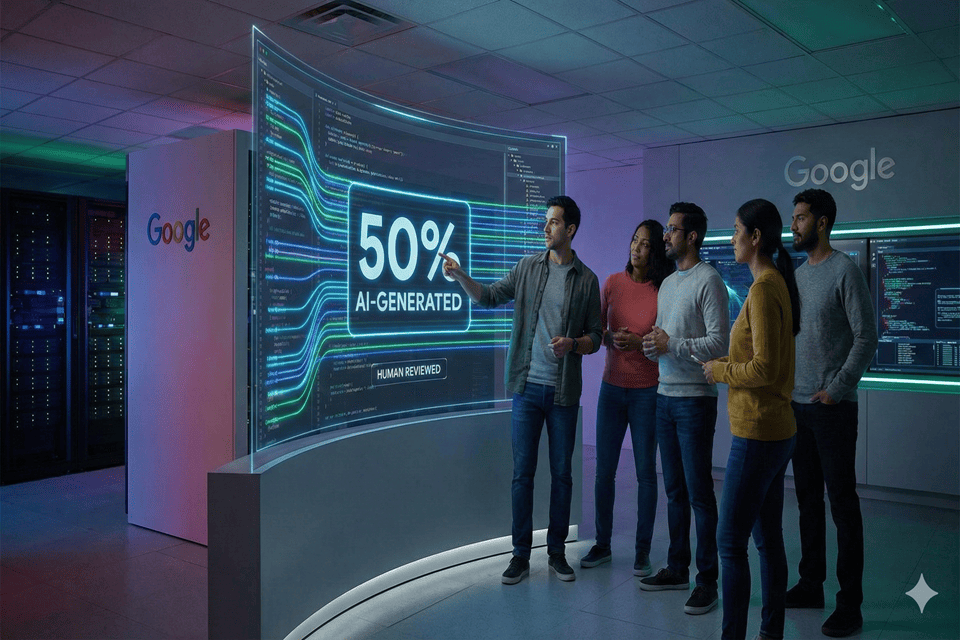
The era of the “manual coder” is officially evolving. In a recent disclosure that sent ripples through the tech industry, Anat Ashkenazi, CFO of Alphabet, confirmed a seismic shift: approximately 50% of Google’s internal code is now generated by AI.
This isn’t a futuristic “what if.” It’s the current reality of how the world’s most powerful search engine and cloud provider operates in 2026.
The Velocity of Change: From 25% to 50%
To understand how quickly this happened, we have to look back at the trajectory. In October 2024, CEO Sundar Pichai noted that AI was responsible for about a quarter of Google’s new code. By April 2025, that number climbed to 30%.
Now, hitting the 50% mark signals that Google has moved past the “experimentation” phase. AI agents are no longer just suggesting snippets; they are architecting the backbone of the company’s infrastructure.
How It Works: The “AI-in-the-Loop” Workflow
Google isn’t letting robots run wild in the repository. The process follows a strict “AI-Generated, Human-Reviewed” model:
- Intent: An engineer describes a feature or a fix.
- Generation: AI coding agents (powered by the latest Gemini models) scaffold the logic, write the boilerplate, and suggest optimizations.
- Review: A human engineer—the “pilot” of the operation—reviews, audits, and accepts the code.
Key Takeaway: The role of the developer is shifting from a “writer” to an “editor and architect.”
Why This Matters for the Industry
Google’s milestone is a signal to every CTO and lead dev on the planet. If the company with the highest code quality standards in the world trusts AI with half its codebase, the “wait and see” approach is over.
- Engineering Velocity: Teams can now ship features in days that used to take weeks.
- Infrastructure Efficiency: Google is projected to spend up to $185 billion on AI infrastructure in 2026 to support these agentic workflows.
- The Talent Gap: The demand for “AI-Ready” developers—those who know how to prompt, audit, and orchestrate multiple AI agents—is skyrocketing.
The Risks: Productivity vs. Technical Debt
It’s not all sunshine and perfect syntax. Industry experts in 2026 are already flagging concerns about “code churn.” While AI can write code fast, it can also lead to:
- Code Duplication: AI tools are linked to a 4x increase in code cloning.
- Maintenance Debt: If the AI generates “spaghetti code” that a human barely understands, fixing it two years from now becomes a nightmare.
- Security Vulnerabilities: Even the best models can hallucinate security flaws that require a meticulous human eye to catch.
Conclusion: Are You Ready for the Agentic Era?
Google’s 50% milestone isn’t just a stat for an earnings call; it’s a blueprint for the future of work. We are entering an era where Engineering Velocity is the only metric that matters, and AI is the engine driving it.
The question for developers and businesses in 2026 isn’t if you will use AI to write your code, but how well you can manage the agents doing the heavy lifting.
What do you think? Is 50% the “sweet spot,” or is Google moving too fast? Let us know in the comments below!
How much of Google’s code is generated by AI?
As of late 2025/early 2026, Alphabet CFO Anat Ashkenazi confirmed that 50% of Google’s code is now generated by AI coding agents. This is an increase from 25% in late 2024 and 30% in early 2025. All AI-generated code at Google undergoes a rigorous human review process before being shipped to production.
FAQ Section (Schema-Friendly)
- Q: Does Google use AI to write all its code?
- A: No, currently 50% is AI-generated, and every line is reviewed by a human engineer to ensure security and quality.
- Q: Which AI does Google use for coding?
- A: Google utilizes internal AI coding agents built on their proprietary Gemini 3 and specialized “Code Think” models.
- Q: Is AI replacing Google engineers?
- A: No. CEO Sundar Pichai has stated that AI is a “productivity booster” that allows engineers to move faster and handle more complex tasks, rather than a replacement for human talent.
